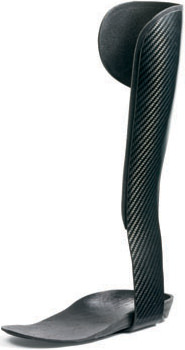
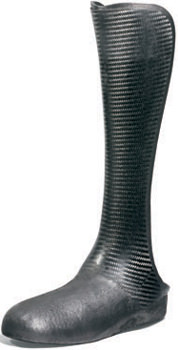
Browse our AFOs.
Benefits
of a
Custom Made Composite AFO
We believe a custom
made composite AFO has a lot to offer, to both the patient and
the practitioner alike. For the patient, a custom made AFO offers
greater comfort and an increase in the function of the brace,
adding to the quality of their life. For the practitioner, it
reduces the fitting time and all the wedging, padding and posting
that a pre-fab AFO may require, making a custom made composite
AFO an appealing alternative.
And
that is our desire—to provide practitioners with another option
for their patients. Not to replace the use of pre-fab braces when
they work, but to give practitioners and their patients a choice.
When composite materials are used effectively, they can create dynamic,
energy return AFOs or extremely rigid ones, while keeping the weight
and profile of the AFO at a minimal. Factor in the patient’s
height, weight, activity level, ankle tendency and the knowledge
and expertise of their practitioner, and we can create a brace that
goes from the box to the patient with relative ease and provides
optimal fit and function.
Frequently Asked Questions
Our
FAQ page provides answers to common questions,
as well as what to do with fitting issues or a brace that needs
repaired.
|
|
What's
New
>
Nike video featuring the Hybrid Medial Strut AFO
Watch
the Nike Strategy to Accelerate Research (Nike STAR)™ video
on Charcot-Marie-Tooth Syndrome featuring our custom made Hybrid
Medial Strut AFO (with calf band). Watch
video >

(Image is property of Nike.)
>
Now Accepting CAD Files by E-mail
With our
new CAD-Cam system we are able to accept STL, Canfit, AOP and AP2
files. Give us a call at 866-273-2230 for more information.
Bracing
Theory
Less
is best. The theory of under-bracing has been around for a long
time. Many times it is hard to determine how much of a brace the
patient needs. Usually after a stroke or recent trauma the patient
may need a lot of stability and depend heavily upon the brace (see
contraindications to carbon
bracing), but as the process of recovery continues less of a brace
is required. Over-bracing decreases the patient’s need to
use their own strength to control the extremity and creates a dependence
on the brace. Under-bracing challenges the patient to strive for
greater gains in strength and balance and replaces just the functions
that are missing. Low-profile composite braces are generally more
accepted by patients and are used more as a result. Identify the
missing function and select a design that replaces it. Think less
rather than more and challenge the patient to achieve greater function,
balance and strength.
|